
Monroe County Recent Arrest Windows
Start with the Monroe County Sheriff's Office, or MCSO. Its Current Arrests page groups bookings by date, newest first, with seven older buckets below. Think of it as a short rolling feed. Nothing there is a permanent archive. Each view carries its own asOf timestamp. MCSO does not promise that a new booking appears at any set minute. Entries can lag, so a missing name is not a missing arrest.
Two dedicated views cover different needs. Arrested Today tracks the newest same-day bucket and intake lag. Arrest Reports covers the wider date run, weekend checks, and records past the public window. Neither one is the live inmate roster.
| Official view | Best use | Key limit |
|---|---|---|
| Newest arrest date | New Monroe County bookings | A fresh intake may not yet be posted |
| Older date buckets | Recent multi-day arrest search | Only exposed dates remain online |
| Current Inmates | Who is in county custody now | Released people drop from the roster |
The MCSO home page links every official channel for arrests, jail records, warrants, the app, and record requests.

That agency navigation is the safest launch point when a saved deep link changes.
When Monroe Arrests Appear
An arrest and its web posting are separate events. Staff identify the person, enter the booking charges, build the jail record, and process the photograph before the public card can be complete. Some MCSO records carry a photo URL. Others show a star placeholder. A blank image proves nothing.
Check the newest date first. Then open Current Inmates, the live custody list that carries its own timestamp. If both searches stay quiet, confirm the spelling and the date, then call the jail or request the record directly. MCSO posts no guaranteed delay between intake and display.
Verify a fresh arrest: A missing web card can mean processing lag, release, transfer, a spelling mismatch, or a restricted record. Check the jail and the docket.
Does a bond figure mean release is final? No. MCSO publishes no bond timetable or fixed roster-removal delay. Confirm the release with MCSO and the Clerk docket.
Search the Monroe Jail Roster
The MCSO Current Inmates roster lists everyone in county custody right now. A record shows a name, sex, race, and birth details. It adds an MNI number, booking and arrest times, facility, hold indicators, charges, bond, and release fields. It is a custody list, not a booking-photo gallery. For a specific photo, use the arrest feed or a public-record request.
Search carefully, since similar names are common. The MNI, or master name index number, separates people cleanly. Facility codes matter too. Monroe spreads detention across Stock Island or Key West, Marathon, and Plantation Key. Every record stays county-centered.
| Roster field | How it helps |
|---|---|
| Name and birth details | Compare identity without relying on name alone |
| MNI or booking number | Use a stable request reference |
| Booking and arrest time | Separate the event from the snapshot |
| Facility | Shows the reported detention location |
| Charges and bond | Shows booking claims, not a disposition |
| Hold or detainer | Flags another custody restriction |
Open Current Inmates, search the exact full name, and compare the MNI and booking time to confirm the match. Check the Clerk record for the arraignment. Call the jail when the status is urgent or unclear. The Current Inmates page shows the official roster interface.
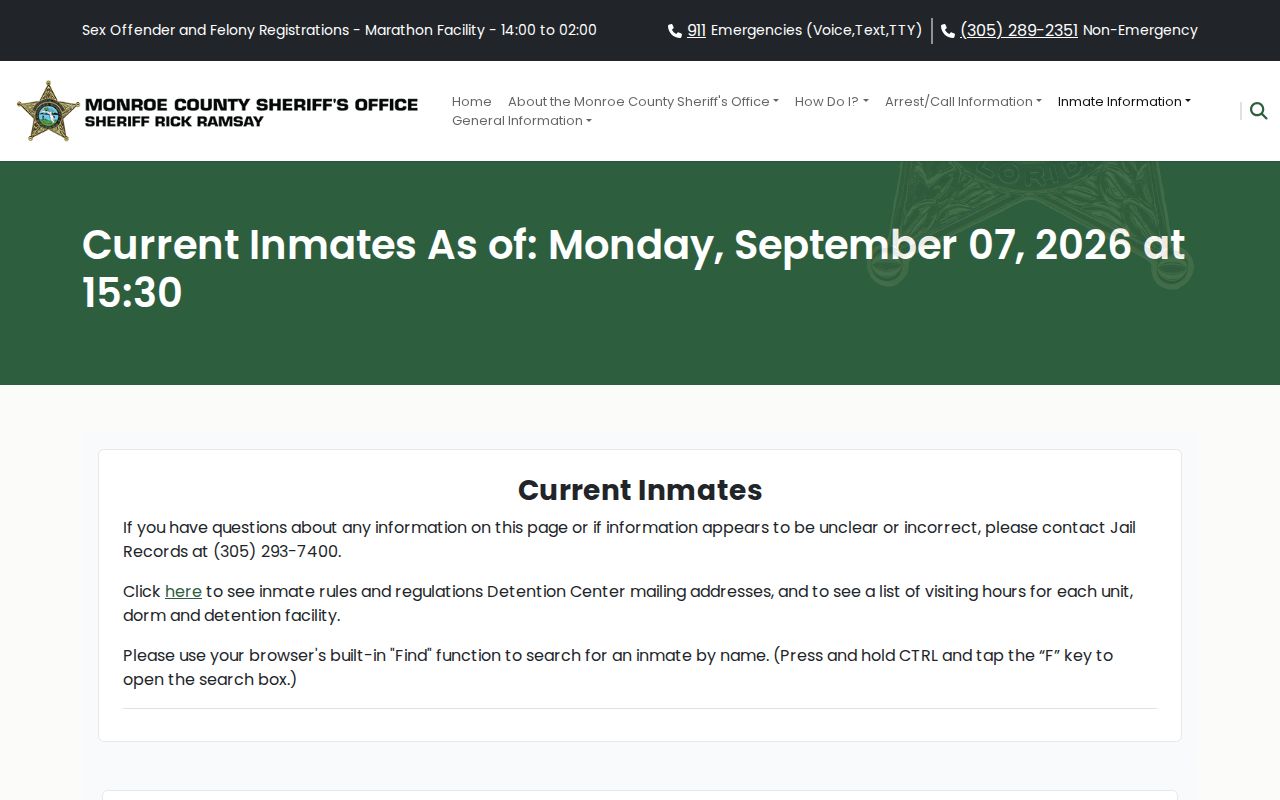
A released person can drop off this view while the arrest and court records live on.
Where Monroe Arrest Records Appear
Custody state decides the source. MCSO comes first for county arrests. The Monroe Clerk carries the case after filing. Florida Department of Corrections, or FDC, covers state prison and supervision, not fresh county bookings. Federal Bureau of Prisons and ICE locators handle their own systems. MCSO also offers an app on Apple and Google Play, but the web feed and records portal remain the record-copy sources.
| Channel | Photo? | Status covered |
|---|---|---|
| MCSO Current Arrests | Some records | Recent county bookings |
| MCSO Current Inmates | No gallery | Current county custody |
| Monroe Clerk | Not the photo source | Court case and disposition |
| FDC Offender Search | Often | State custody or supervision |
| Local news | Sometimes | Selected incidents only |
| Unofficial indexes | Often | Copied or stale entries |
Keys Weekly and FL Keys News publish selected stories. Unofficial Monroe pages on RecentlyBooked, Mugshots.com, Arrests.org, Busted Newspaper, and Mugshots.zone may keep copied entries, but they carry no MCSO freshness guarantee. The Keys Weekly crime archive shows how selective news coverage runs.
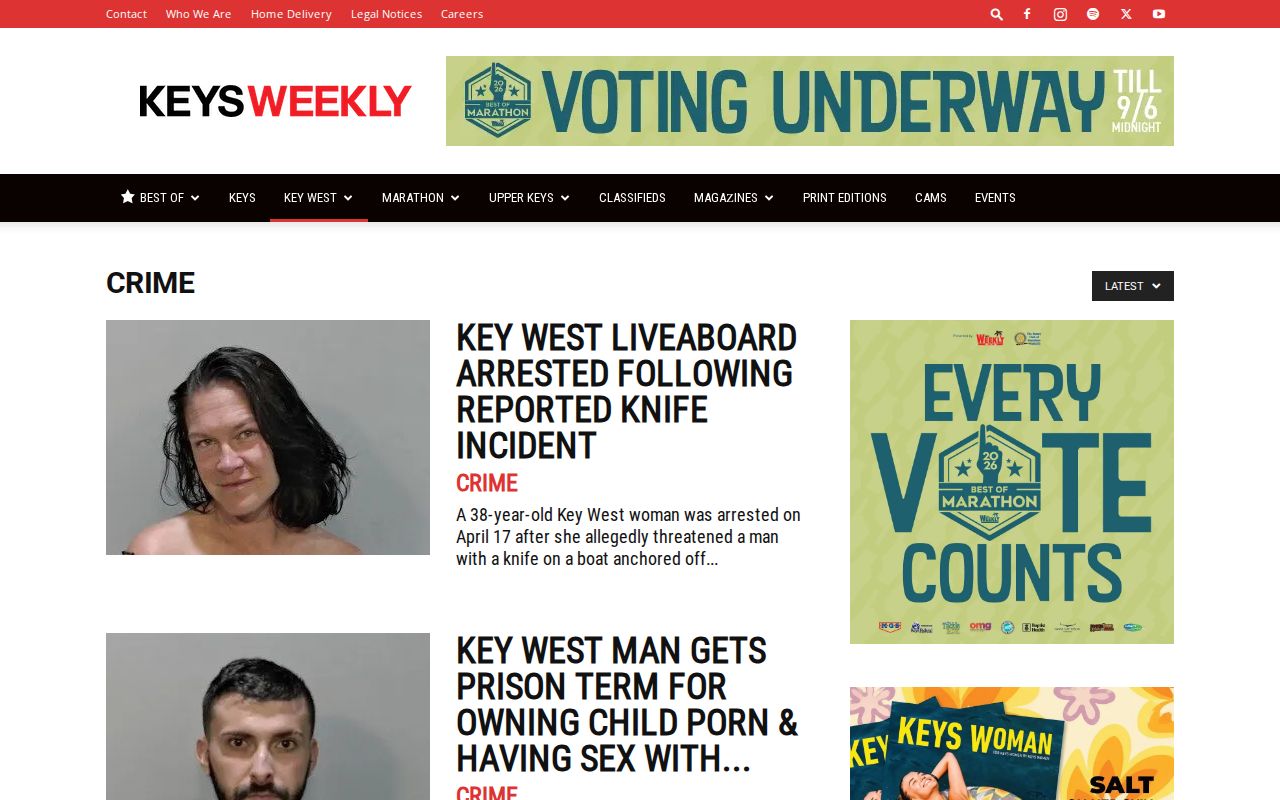
Publication choices make it context, not a complete booking check.
Recent Arrests by Monroe City
City lines decide who owns an incident report, but county booking is the common thread. Key West runs its own police department. Marathon lists MCSO as its law-enforcement contact. Islamorada routes law-enforcement copies to MCSO, and no city offers its own complete daily booking feed.
- Key West Recent Arrests separates a KWPD report from an MCSO booking.
- Marathon Recent Arrests explains the sheriff-policed route and city records limits.
- Islamorada Recent Arrests follows the village FAQ to MCSO contacts.
Each route runs from the new-booking feed to current custody, a record request, and then the Clerk disposition. News comes last.
Inside a Monroe Arrest Record
An MCSO record can list the displayed name, birth details, sex, race, arrest date and time, location, CAD incident number, offense number, officer, bond, arraignment entry, and charges. Each charge may carry a class, Florida statute, description, count, and case information. Address and occupation appear sometimes. They rarely matter for an identity check.
| Record field | Meaning |
|---|---|
| Name and descriptors | Identity data recorded at booking |
| Arrest date, time, location | Event details supplied to MCSO |
| CAD and offense numbers | Precise request references |
| Charges and statute | Accusations entered at booking |
| Bond and arraignment | Early fields that may change |
| Photo or placeholder | A record image when supplied |
After booking: The arraignment entry and case information point to the court file. The Clerk's docket supplies the outcome.
- Booking
- Jail intake that creates the record.
- Arraignment
- An early court stage when charges are addressed.
- Bond
- A court-set release condition.
- Disposition
- The recorded outcome.
- Detainer
- A hold from another authority.
Monroe Arrest Photos and Mugshots
Every Monroe booking photo belongs to a record. It is not a gallery of its own. Current Arrests displays the image whenever the underlying record carries a photo URL. Other cards fall back to a placeholder. A card can also roll out of view or show no picture at all. In that case, request the maintained photograph straight from MCSO through its records portal.
FDC's Offender Search works differently, and the FDC search menu makes that scope plain. It may return an offender image for someone in state custody. It is not a county booking feed.
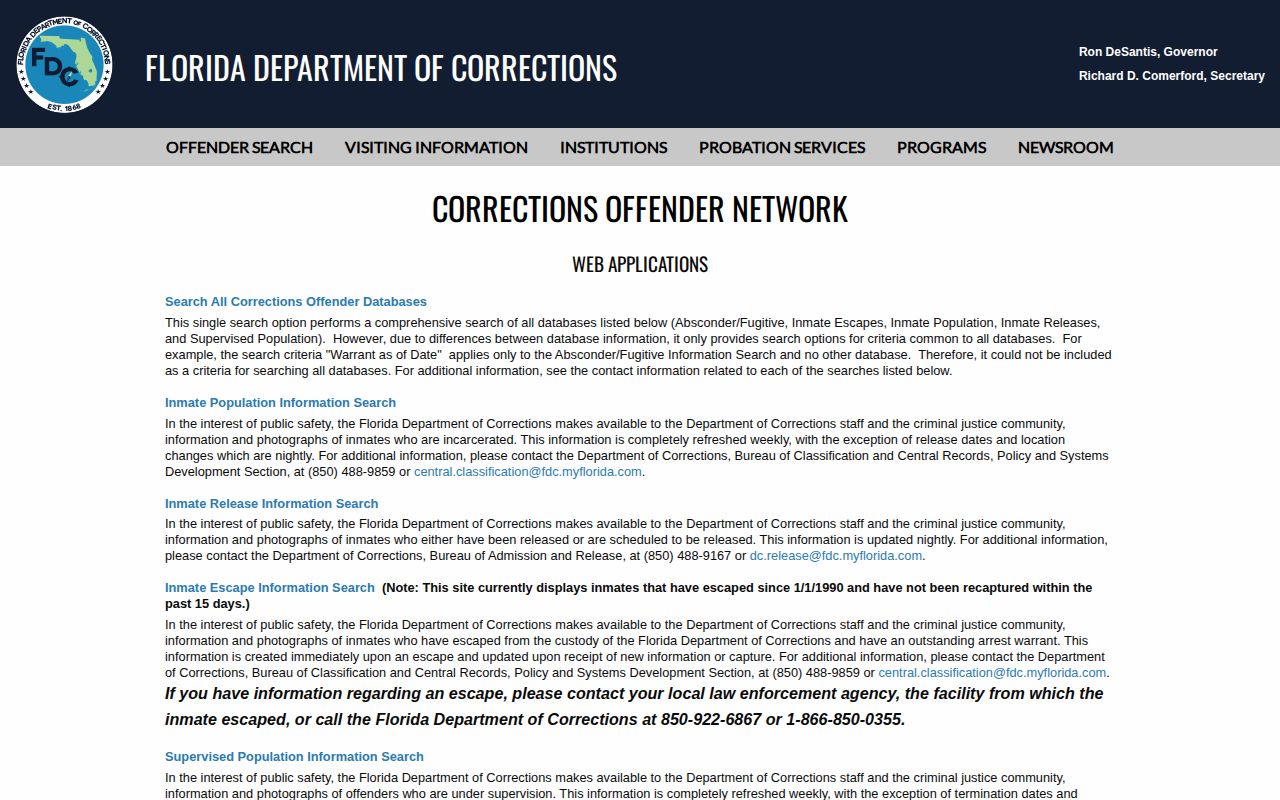
Federal locators are no better as Monroe mugshot archives. Can an unofficial photo settle identity? No. A private index can sit stale or miss a correction entirely. Compare identifiers with MCSO and confirm the court result before trusting what you see.
Request a Monroe Arrest Record
The formal route runs through MCSO JustFOIA. Include the full name plus any booking, MNI, CAD, or offense number, a date range, the likely facility, and the exact items you want. That could mean the booking card, affidavit, release record, or photograph.
- Identify MCSO as the booking-record custodian.
- Give dates and every known record number.
- Name each report or photo sought.
- Ask for an estimate before extensive work.
- Ask which exemption applies if access is denied.
Florida law grants inspection and copies, exemptions permitting. MCSO posts no flat fee or fixed turnaround for every photo request; the custodian quotes the actual cost. Keep that estimate separate from the Clerk's criminal-record-letter fees. When a web card rolls off the site, the official request portal remains the fallback.
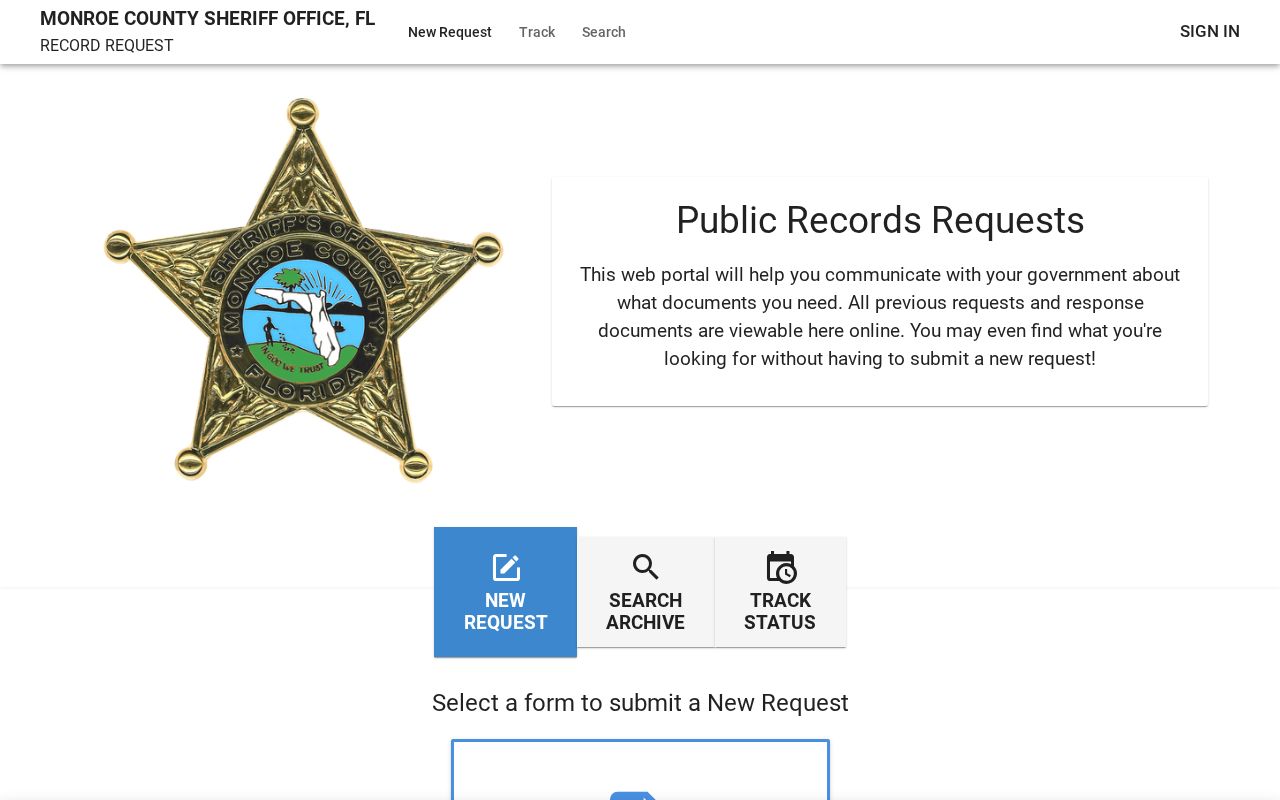
Keep the confirmation and respond if the custodian asks for a narrower request.
Florida Arrest Records and Removal Law
Florida Statutes §119.07 builds the access and copy framework. GS2 sets retention at one anniversary year after release for booking records and for the 24-hour commitment and release lists. Daily inmate headcounts are held at least one fiscal year. Those are retention benchmarks. They promise nothing about web display.
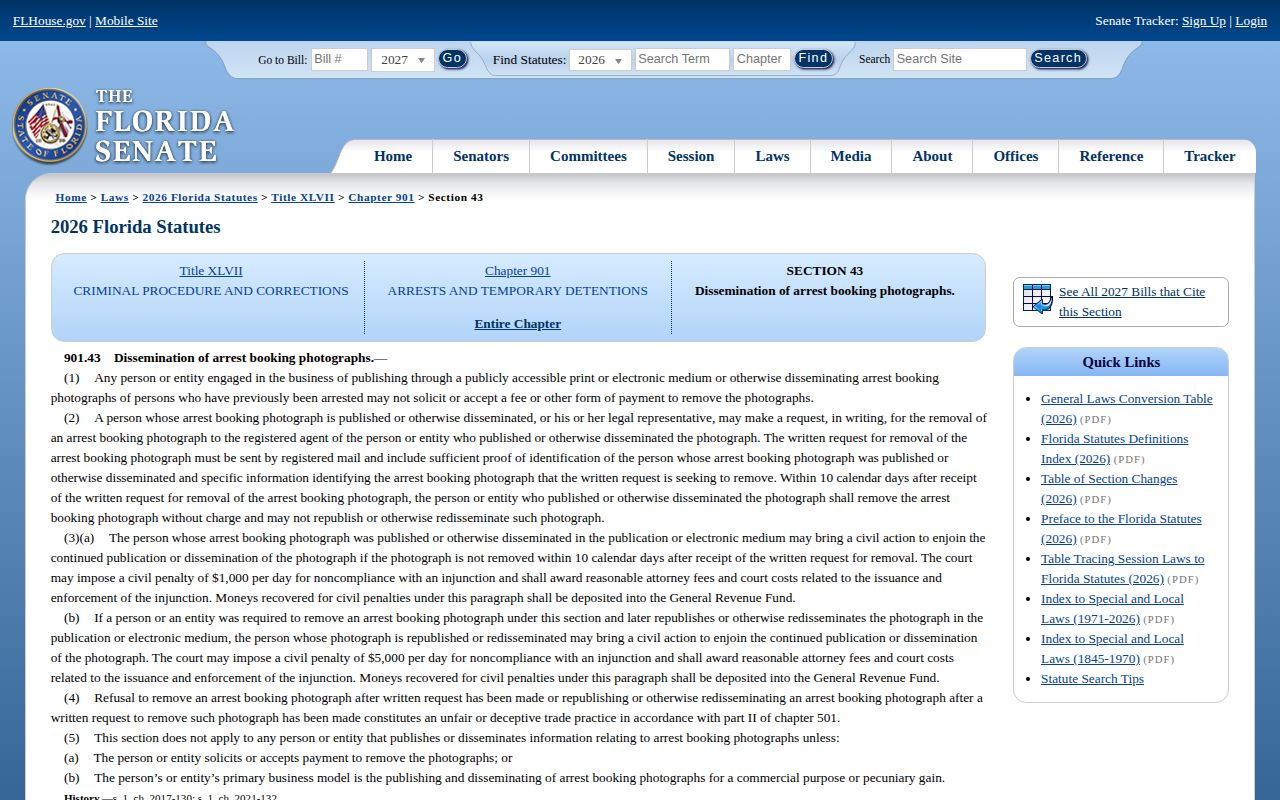
Florida Statutes §901.43 targets certain publishers. Those publishers solicit or accept money to remove qualifying arrest photos. Under the law, a written request goes to the registered agent. A ten-calendar-day period applies, and republication is barred. The statute page carries the controlling text. It still does not erase every story or archive on demand.
Never pay for a promise to erase an official record. Fix the source first. RecentlyBooked, Mugshots.com, and Mugshots.zone each state free correction or removal paths for some cases. Busted Newspaper and Arrests.org list no Monroe-specific free path. Once a source changes, Google's outdated-content refresh can update a stale search result.
The FDLE process stands apart from all of that. A Certificate of Eligibility is usually an early step. A court decides any relief. Juvenile, sealed, expunged, and confidential records may stay out of public view. An empty search proves nothing about whether an event occurred.
Monroe Arrest Warrants and Wanted Records
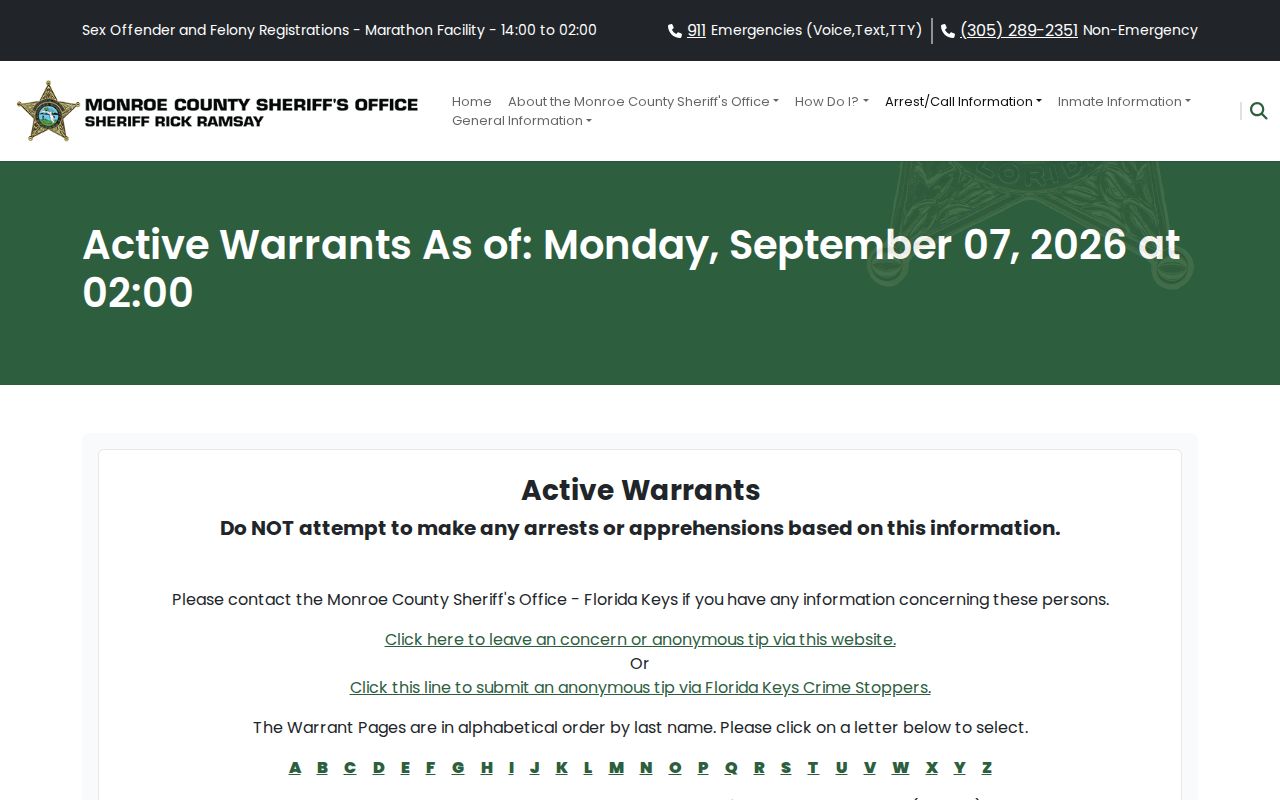
The sheriff's office posts Active Warrants on its site, sorted by the first letter of a last name. Each entry can carry identity details, warrant or case numbers, bond, and a booking photo. A date stamp marks the page. MCSO also warns visitors plainly. Do not approach anyone listed there.
Anyone with a warrant question can check with MCSO or the issuing court, since only those offices confirm current status. A person who believes a Monroe County warrant carries their own name should call a Florida attorney and respond through the court. Tips go straight to law enforcement.
The official warrant index displays the letter-by-letter lookup and the safety warning.
A warrant allegation is not a conviction. Confirm live status.
After a Monroe County Arrest
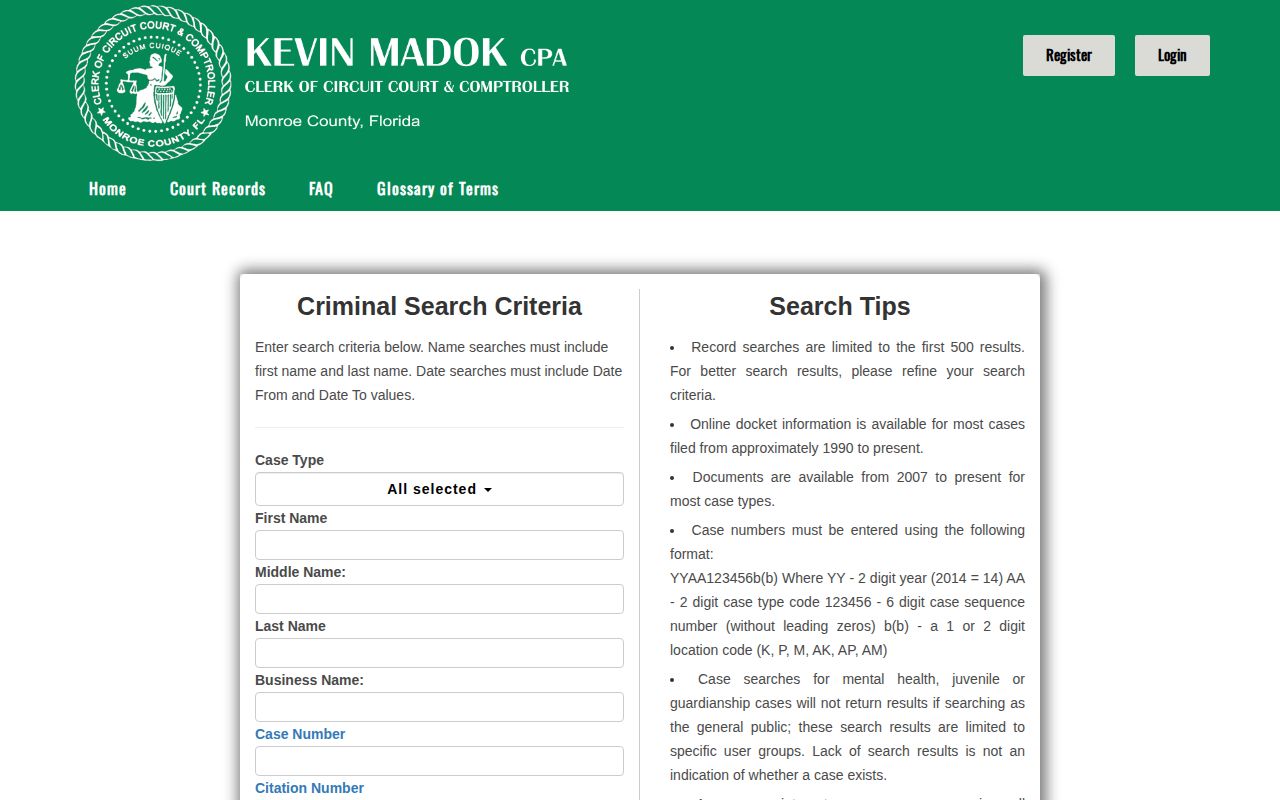
The arrest feed marks a case's start, never its end. The Monroe Clerk criminal search bridges that gap. Name, date, and case-type filters lead to case number, location, charges, docket activity, and documents. Broad searches can hit a 500-result cap, so precise identifiers pay off. Restricted matters stay closed to ordinary remote access.
Arraignment is an early court event. An MCSO arraignment field only points toward it. The Clerk docket carries the history forward. The Clerk search shows the bridge from booking to court. A disposition is the outcome. Charges often change, get reduced, or fall away.
The docket may remain after the short booking window, subject to access limits.
Older Monroe Records and Custody
Old records split by custodian. A county booking or photo goes to MCSO. A court result belongs to the Clerk. State custody goes to FDC. Federal populations sit with BOP or ICE. VINE Arrest Check covers custody status and notices for one person, not arrest history. Someone just booked may appear in the MCSO arrest feed before other systems catch up. A person still held stays on Current Inmates. After release, that roster drops them. The booking card, agency file, and court case persist.
| Question | Source |
|---|---|
| Original county booking or photo | MCSO records |
| Current county custody | Current Inmates, VINE, jail contact |
| Case outcome | Monroe Clerk |
| State custody or photo | FDC |
| Federal custody | BOP or ICE |
| Historic agency file | Local custodian, then Archives of Florida |
State archives do not receive every booking card automatically, and many holdings sit undigitized. The Archives of Florida collects historically significant state and selected local records. Ordinary Monroe booking files may stay with the creating agency. Name the series, person, date, and facility. Include any booking, MNI, CAD, or case identifiers in the archival request. That detail lets a custodian pull the right record without sweeping unrelated files.
FDLE's 2019 county and municipal table reported 4,246 Monroe County arrests. Treat that figure as a dated benchmark. It says nothing about today's booking volume. It cannot show who is in custody now. It cannot count the cards in the rolling web window or trace how a later court case resolved.
Monroe Booking Fees and Timing
Fees in Monroe County hinge on which office holds the record you want. Florida's public-record statute sets broad copy benchmarks and allows extra charges when a request demands heavy staff or technology use. The MCSO arrest page posts no flat rate for a booking card or photograph. Ask the records custodian for an estimate first. Approve any extensive-work charge before staff start the job.
The Clerk keeps its own price list for criminal-record letters. Each year searched costs two dollars. Pages run one dollar apiece, and certification adds two dollars more. Those are Clerk charges, not MCSO booking-photo fees. Timing differs too. A web arrest card is free to view. A certified court copy or a broad archival request may require payment up front.
No office promises one universal turnaround. A narrow request moves faster because it names the agency, the person, the date span, the record type, and any known control number. Need current custody status rather than a copy? Skip the public-record route and check the roster or call the jail directly.
Monroe Detention Across the Keys
Island geography shapes every Monroe County lookup. The Keys stretch over a hundred miles, so MCSO spreads detention duties across them. The state jail directory lists the main jail at 5501 College Road in Key West. MCSO also points to detention locations in Marathon and Plantation Key. Three sites do not mean three booking archives. One county system holds the booking data for all of them.
A facility field on a live record shows one thing. It marks where the person is held or processed. It never changes who maintains the county booking file. Start with MCSO for every location. Keep the MNI or booking number handy, and name the facility in any later records request. If a transfer sends the person to FDC or a federal authority, follow that receiving system instead of reading a stale county card as current status.
The same logic clears up a common mix-up. KWPD, MCSO, or another agency may make the arrest, yet MCSO maintains the jail booking. So the incident report and the booking record can sit with different custodians. Both may describe the same event.